Posts

Showing posts with the label Reading

Week 15 Extra Credit Reading Notes: Laos Part A

Image
For my final reading assignment, I decided to look into the Laos subunit, which caught my eye when I was looking for more readings to do. I quite liked the stories that were told as they had to do with a lot of animals that are in those parts of the world – I also liked it because of the spirits that were constantly present throughout the story. An example of a kind spirit was when a Hunter came to the enchanted mountain, his arrows could not pierce the breast of any fowl that were nearby. This was because they were protected by the spirits that roamed there. My personal favorite story out of the unit was, “The Enchanted Mountain” which described and detailed a mystical place on top of a mountain that only those who are completely exhausted from the hard labor that was hunting can discover. People attempted to find it naturally, after hearing of the renewing water, the plentiful fruit, and the amazing amount of animals that can be found there. I could definitely write a great story a...

Week 15 Reading: Dante's Inferno Part B

Image
Again, Dante’s depictions of hell truly sends shivers down my spine. For today’s readings, he is sent further down into hell, out of necessity to escape. Guided by Virgil who was sent from a goddess, Dante sees with his own eyes the bottom circles of hell. The seventh circle is punishment for those who commit violence, with 3 rings for different kinds of violence. The first ring is “against neighbors” where a brutal scene of souls trapped in boiling blood and fire – if the sinner emerges too high above the river of blood, three centaurs would shoot them full of arrows for them to sink back lower into their punishment. Ring 2 in the seventh circle somewhat scarred me, with it being violence against self that is punished. People are turned into trees, where they are then fed upon eternally by the harpies – only when they are damaged are they allowed to speak. Overall, these punishments are truly horrific to think about, maybe showing that Dante wanted people to save their souls bef...

Week 15 Reading: Dante's Inferno Part A

Image
During this final week of school I decided to read one of the most famous works of literature, “Dante’s Inferno”. I have had experience with this story before, so most of it is not new to me. Overall, I love the themes that are explored within the story, alongside how they are described. Doing some research into this, this was one of the first stories to depict Hell as such a place. Differing levels, with a guide leading him have captured imaginations everywhere. Today, there are so many different stories about Hell, or the people that go there, or even about the devil himself. They each describe Hell in their unique way, but all have one thing in common – suffering. I mean, what else is there to have within Hell? I love the way that Dante described what it was like when he first heard the sounds of Hell, “Here sighs, complaints and deep groans sounded through the starless air, so that it made me weep at first. Many tongues, a terrible crying, words of sadness, accents of anger…” All...

Reading Week 14: Brother's Grimm (Crane) Part B

Image
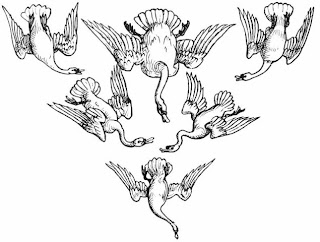
The Brothers Grimm have a highly distinct story telling style that encapsulates what it means to tell old fairy tale stories. They’re filled with easy to follow plots that progress in a logical manner, they have rich detail the captures the essence of the story, and finally, they have gruesome details that really hone in on how it is VERY bad to be evil in these stories. This week, my favorite two stories out of the bunch were “The Six Swans” and “King Thrushbeard”. I was originally more of a fan of King Thrushbeard, but now looking back on how it ended/what took place to get there, I appreciate The Six Swans more. Each was filled with great details that highlighted exactly where the characters were in the story. An example of this is when the swans finally appeared, “and the fire was about the be kindled, all at once she cried out loud, for there were six swans coming flying through the air, and she saw that her deliverance was near, and her heart beat for joy.” Choice words her...

Reading, Week 14: Brothers Grimm (Crane) Part A

Image
The first stories from the Crane unit of the Brothers Grimm were quite enjoyable to read. I remember reading some of their stories in the past, but I haven’t read these before. I obviously recognized “Aschenputtel” as it is the original Cinderella story, but with the other two, “ The Fisherman and His Wife” and “The Robber Bridegroom” I had never heard of before. There were a few distinct things that set these stories apart from ones I’ve read in the past. First, these stories were super dark. The first one wasn’t too bad, with a valuable lesson being taught (which was don’t be greedy if given something good), but the other two had some pretty intense violence. In Aschenputtel, the evil sisters cut off parts of their feet in order to fit into the shoe that the Prince brought by. I wish Disney kept this in the movie, definitely would’ve added a more adult rating! (just kidding) At the end of the story, in traditional Brothers Grimm fashion, the evil sisters get their comeuppance when ...

Reading Notes: Through the Looking-Glass, Part B

Image
Again, Lewis Carroll does a great job of subverting expectations and giving us a great reason to keep reading his works! The situations that Alice finds herself in keep on getting stranger and stranger, with the story eventually culminating in her becoming a queen in Wonderland! Who could have seen that coming? The characters that she surrounds herself with are again unique and entertaining. My personal favorite is the Red Queen, with her evil-like, no-nonsense attitude. This is characterized extremely well through quotes such as, “Speak when you’re spoken to!” and “You can’t be a Queen, you know, till you’ve passed the proper examination”. This shows that she relies on what being a queen is all about, that she won’t let anyone take a queen spot who isn’t worthy, especially not someone as young and as normal as Alice. The Red Queen further humiliates Alice, making her seem less in their eyes, by asking her odd type of math problems. This is a recurring theme throughout Alice’s advent...

Reading Notes: Through the Looking Glass, Part A

Image
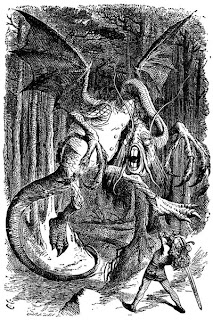
Lewis Carroll has such an interesting way of telling a story. Not only are the characters that he creates unique and inventive, but they stand out which such vivid detail that is it just tremendously easy to imagine them. The way he uses words is also highly distinct – whimsy cuts through the story because of the dialog between the normal Alice and the absolutely abnormal circumstances. I’ve never read the sequel of Alice in Wonderland, so this was interesting for me to read it. It was obvious right from the start that this was a sequel to such a fabulous adventure from last time. He also has a ways of putting pretty fantastic poetry within his stories, something that people struggle with JUST having a poem in the middle. An example of fine poetry (that’s funny at the same time) was the “Jabberwocky” poem, which was filled with all sorts of great wordplay and odd use of language. An example of odd wording was, “ ‘Twas brillig, and the slithy toves”. I’m not even sure what this ph...

Reading Notes: Alice in Wonderland Part B

Image
This week’s reading of Alice in Wonderland was full of even more of the expected whimsy and great characters. After thinking about it after last night, I came to one of the conclusions that part of the reason why Alice in Wonderland is so widely read about and praised is because of the characters and setting that the story in contained within. It brings out everyone’s childlike wonder, with a touch of imagination thrown in to build the characters. Every character is unique and different from any of those around them. They stick out like a sore thumb and will plant themselves in your imagination. Take, for example, the Mad Hatter, The Dormouse, and the March Hare (which were read about today). While sharing one larger trait (they were all crazy!) they each had derivatives of this that made them stand out, providing great interactions between the seemingly normal Alice and themselves. By having a contrast in insanity, Carroll is able to defy expectations by making Alice seem the cr...

Reading Notes: Alice in Wonderland Part A

Image
This week's readings were something that I have definitely heard before - Alice in Wonderland by Lewis Carroll is a staple of most children's early lives. The whimsical story that is laid out by Carroll is rich in detail and the right bit of silliness to appeal to so many throughout the world. But what makes it so special to everyone? There have been stories in the past that are similar. Maybe it was because this book almost pioneered this type of fantasy writing. Not taking everything so seriously, making sure that the story is actually fun to those who read it, and the fact that it's characters/situations are so unique. My favorite sections of this week's readings was "Advice from a Caterpillar" (although when she fell down the rabbit-hole was a close second). The reasoning behind my liking it was the conversation that the two of them had between each other. From going round in circles about asking who each person was, to the grumpy/mean disposition that h...

Reading Notes: Sioux Unit Part B

Image
This week’s readings of the Sioux tribe were highly interesting. First off, the vivid details that were consistently conveyed across multiple stories were highly consistent and rich. An example of this was in the story Iktomi’s Blanket when it was speaking of the season changes from the perspective of the Great Spirit (another common theme that I’ll go over) that stated, “snow-white blanket” and “everlasting hill”. These two description words were obviously used with a purpose of creating a more mystical-type of tone, one of reverence for the Great Spirit who controls so much of these Native American lives. A big theme that I could see within these stories was one of familial ties. Obviously, family is important to so many different cultures throughout the world, but it can be seen even more evidently in these short stories. Iktomi’s grandfather is seen throughout the story, he is prayed to, and his ancestors are further involved with the story. This type of theme is always inter...

Reading Notes Week 10: Great Plains Part B

Image
Today’s readings included some Native American ghost stories, which are a bit different than the traditional ghost stories that most think of. In these, the ghosts are physical beings, present, ever-watching within certain areas of the woods. Hunters have to take precautions to avoid the ghosts while protecting themselves. In one of the stories a hunter is circled in upon, like a rabbit in a snare, by a multitude of ghosts – when one gets close enough to attack him, the hunter shot it in the head, sending them away. Normally, when I think of ghosts, I think of entities that can’t be harmed by normal weapons such as a gun – only by supernatural related objects. Other stories that I quite liked were the ones that dealt with the animals. In a bunch of stories, the rabbit was the “main character” where a couple of things were explained about why the rabbit is the way that it is. A depressing story that I read within this unit was in the second one called, “The Wakanda” where a boy wi...

Reading Week 10: Great Plains, Part A

Image
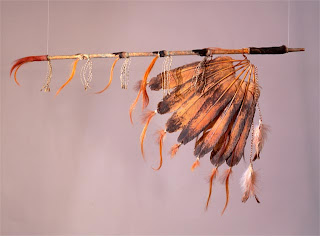
The Great Plains stories that I was able to read this week had many interesting details that were associated with them. I liked how they described the world before life was on it. That it was just water everywhere – then the water would recede at the beckoning of an animal to one of the gods (or land would arise up). This supernatural sounding landscape, that would be molded before human’s eyes is an image that will probably stick with me – it’d be a good way to open some kind of creation story (or a story about the way things are). Other types of stories that I saw during this unit included ones that described the first time the Native Americans started having a tradition. Examples of this were: smoking of a peace pipe/why they would do that and why/how a pole was to be worshiped. The stories seemed almost dreamlike at certain points, with impressive feats (or seemingly important details) would be casually brushed over. I feel like one of the most important stories to this unit ...

Reading Notes Week 9: Nigeria Stories, Part B

Image
These Nigeria folk tales are the type I especially like. I’m not sure if it is because of the simplicity or the actual stories themselves, but overall, they are quite to my liking. My favorite story out of the bunch was the one about the hippo and the tortoise. All of these stories have plots that are easy to follow along, but in the traditional folklore way, they have seemingly random conflicts throw in. What I mean by random can be seen in the Hippo story and the Elephant vs bush cow story. For the first, the hippo invites all these animals to eat with him and his seven wives, but once his guests get there, he proclaims that they aren’t allowed to eat unless they can call him by his name. For the elephant story, the monkey who is trying to tell the chief about the fight happening where it shouldn’t gets heavily distracted on his way to tell, then once he gets there, it takes him a little while to tell the chief something. I’m not really sure what this adds to the story other than m...

Reading Notes Week 9: Nigeria Unit Part A

Image
I quite liked the Nigeria stories – they were simple and had themes/explanations that matched what I think of when I think of fables. They explained why animals are the way that they are, they had some life lessons, and finally, they were actually humorous (even though there were some pretty intense deaths). One of my favorite stories that was told was, “The Disobedient Daughter Who Married a Skull”. It again deals with the re-occurring theme of being careful who you marry. This daughter, who was described as one of the fairest maidens throughout the land, had only the highest of standards in the man who she would choose to marry. She didn’t want to marry her father’s friends (which makes sense to me) or any other man who came up to her, asking for her hand in marriage. Eventually, a skull from the spirit lands (which I love the name of) gathered body parts from people he knew (another scary image) in order to appear as the best-looking man this woman had seen. She then married h...

Reading Notes: Japanese Mythology Part B

Image
Again, these Japanese mythology tales convey a supreme sense of mysticism along with a calming type of presence – this can be seen through phrases such as, “sweet ambrosial sake they poured into cups of frail-stemmed sea-lillies” these carefully chosen words convey so well what the images are within the stories, exactly how they need to be described. I also liked the hero’s (Yamato) quest to find new love (even at the expense of his previous love). The golden apple is also found within this collection of stories, another artifact/symbol that can be found throughout mythology in the world. You can even see an example of the golden apple in video games! The idea that some fruit can grant you eternal life/bliss is such a great concept to put into a story – having an everyday, normal object with such extreme powers causing men to search after it heedlessly is a great concept to explore. Again, there is a monster slayed within the story, with the Great Boar taking that spot. The challenge...

Reading Notes: Japanese Mythology Part A

Image
This week’s reading was very interesting, especially since I had never really heard about or read Japanese mythology. One of my favorite stories from this unit was the 8-forked serpent of Koshi. I read this earlier in the class, which is part of the reason that I liked it so much. Other reasons were I simply like fantasy stories where the main character is able to triumph over some huge monster through his wits alone.  Furthermore, he wound up with a beautiful wife at the end of it, for his troubles – when stories like these end well with a heroes ending, it makes me think of an earlier time in my life. The types of stories that have “good” endings are ones that are looked highly upon by children. I also liked the stories at the beginning, which described how life came to be through a flower that bloomed the Izanagi and Izanami, who then shaped the Earth with a spear, drawing up mountains and carving out valleys. The overall tone of the stories was mystical, etherea...

Reading Week 2: Persian Tales Part A

Image
These Persian stories were very surreal – the characters just seemed to do random things that managed to either work out in a completely different way than you thought or seemed to have no motive. In one story, a woman cuts off her two thumbs in front of her daughter after hearing about multiple other beings doing something similar. From shaking feathers to muddying up the creek, these beings responded to a terrible thing happening in very odd, but somewhat endearing ways. They felt the pain of Mushu, who’s new wife had just drowned in a pot of soup because the wind had pushed her into it (see what I mean by surreal??). The overall tones of the stories reminded me of a simple narrator, that had very odd ideas for what a story was compromised of. They really didn’t have a plot per-say, they mainly focused on the characters doing fantastical things that pushed the story forward in some way. Things “just happened” that didn’t have any forewarning during the story – the second story ...

Reading Notes: Ancient Egypt Part B

Reading Notes: Ancient Egypt Part A

Image
For this week’s reading, I decided to go over the Ancient Egypt stories because I’ve always found the gods of Egypt extremely interesting. First off, these stories were definitely not what I was expecting – I never realized that the gods of Egypt were at one point human. That makes the gods that much more relatable in the stories told about them, that they walked the Earth just like their believers/subjects, that their power could be seen directly by those who followed them. However, moving on from this, some of these stories were a little disturbing. The most obvious disturbing event from these stories happened in the “Death of Osiris” story, where his brother Set tricks him into laying in a coffin, thereby trapping and killing him. Furthermore, the coffin is thrown into the Nile, where it eventually lands in Syria. It doesn’t end there, though. Osiris’s wife, Isis is so distraught over his death that she endlessly looks for his coffin – when she finds it, she winds up slaying m...

Reading Notes: Odyssey Part B

Image
The next set of readings that I did delved mainly into Odysseus dealing with the ghosts of those who are found in Hades after dying. He needed to deal with them in these stories in order to gain a prophesy from Teiresias. This type of thing within a story (an oracle) can lead to some great plot points, especially if they’re crafted in a way as to not give away the entire story, but add some tension to it, dreading what is going to happen in the future. I felt sorry for multiple of the ghosts, mainly Elpenor, who died because he got too drunk to remember where he fell asleep, leading him to plunge to his death from a roof, breaking his neck. This death just seemed pointless except for the fact that now Odysseus had to go back to Circe and gather his body to burn it. The idea of communicating with the dead from our past has some importance, especially when it’s a beloved friend or family member. The emotional significance for the hero of the story when he meets his mother’s ghost is...